Showing posts with label Italian Wars. Show all posts

Sheffield Triples Game - Cerignola 1503

THE CAMPAIGN FOR THE KINGDOM NAPLES
AND THE BATTLE OF CERIGNOLA


Including random photos of the game, which won second prize for best demo, at Sheffield Triples 2013
In 1500 Louis XII determined that he would re-conquer the Kingdom of Naples for France. In June 1501 his army, under the command of Louis d’Armagnac Duc de Nemours, began to mass in Rome in readiness for the invasion. King Federigo of Naples anxiously watched the French preparations and frantically tried to raise an army of defence; his one consolation was that several thousand Spanish troops under the command of his friend Gonsalvo de Cordoba had crossed the Straits of Messina to land in the south of his Kingdom. It seemed as though Federigo’s uncle, King Ferdinand of Spain, was coming to his rescue.


Just before the French army departed south Pope Alexander VI disclosed the secret Treaty of Granada signed on 11th November 1500. By the provisions of the treaty King Federigo would be forced to abdicate and his kingdom would be divided. King Louis XII of France would become King of Naples and take control of Naples, Terra di Lavoro and Abruzzi. King Ferdinand of Spain would take the title Duke of Calabria and control of Calabria and Apulia. Federigo had been stitched up by his own family.


By the spring of 1502 it was all over for the old regime. The Kingdom had been occupied and divided by the armies of France and Spain. But not everything was settled. Two important regions in the Kingdom, Capitanata and Basilicata, were not mentioned in the treaty and both France and Spain laid claim to them. By the summer of 1502 what had started as angry skirmishes between French and Spanish outposts in the contested provinces had escalated into open hostilities.

The Spanish army was heavily outnumbered by the French. Fearing that he would be overrun Gonsalvo ordered most of his troops to concentrate at, and fortify, the port of Barletta on the coast of Apulia. There he would await reinforcements and events. Nemours moved the French army to blockade Barletta. Gonsalvo wisely refused to give battle and Nemours secured most of the rest of Apulia for France.


Gonsalvo’s situation in Apulia began to change from the autumn of 1502. Nemours divided his army and sent a strong force to occupy Calabria; Nemours lifted the blockade of Barletta to put his army into winter quarters; Gonsalvo was reinforced - including a contingent of seven regiments of veteran landsknecht pikemen; in late February 1503, Gonsalvo led a sortie out of Barletta and took the town of Ruvo, capturing the French captain La Palisse, 150 gendarmes and 800 infantry. The scales were in balance (both sides were now equal in number with about 10,000 men each). Gonsalvo decided that the time had come to seek a battle with Nemours. On 27th April 1503 Gonsalvo marched his army out of Barletta and Nemours moved to confront him.

The Spanish army arrived at the hill top town of Cerignola on 28th April. It was a swelteringly hot day but, rather than rest his men after their hard and dusty march, he set them to deepening and widening a wet ditch at the foot of Cerignola’s vine clad slopes. The spoil, held together with stakes and vines grubbed up from the hill side above, were piled into a low rampart. This rampart, lined end to end with thousands of arquebusier (early musketeers) would decide the battle to come.

The French were marching to Cerignola, strung out along the road, advancing without reconnaissance, and harassed by Spanish light cavalry. It was very late in the day when they finally arrived before Cerignola. On seeing the Spanish army below the town the French held a council of war to determine their next move.
The Duc de Nemours favoured waiting until morning before attacking. This would allow his artillery (struggling up the road some distance to the rear) to come up, and his tired infantry (some of whom had suffered heat stroke) to rest after their long, hot march. Many of Nemours’ captains disagreed. Even though the army had not yet fully come up Yves d’Alégre, amongst others, urged an immediate attack. Surely, they said, one violent attack with a combination of the Swiss and Gendarmes that were present would decide the battle – as they always had – and afterwards they could all sleep, victorious, in comfortable beds in the town. The council became argumentative and Nemours was forced to bow to his officer’s wishes. No one in the French army had seen the deepened ditch and rampart.

The French deployed in three columns, echeloned from right to left. The right wing under Louis d’Ars comprised heavy and light cavalry. The centre comprised the Swiss under Tambien Chandieu and the Gascon infantry. The right, which had not fully arrived on the field, comprised heavy and light cavalry under Yves d’Alégre. The artillery was still on the road and miles away.

The Spanish deployed behind their rampart. In the centre of the line Gonsalvo placed his German landsknechts under the command of Fabricio Zamudio. To either flank of the landsknechts were Spanish infantry, deployed for the first time in permanently organised battalions called coronela. These were commanded by Pizarro and Diego Garcia de Paredes. The front was effectively manned by arquebusiers from end to end. The mixed Italian and Spanish cavalry was drawn up, in reserve, behind the wings and centre. The heavy cavalry was commanded by Fabrizio Colonna on the left, and by Gonsalvo de Cordoba in the centre. The light cavalry was, after coming in from its harassing duties, placed on the right. The artillery was drawn up on the crest of the slope and was trained on D’Ars’ heavy cavalry.

Nemours ordered the trumpets to sound the attack. The French line moved forward under fire from Spanish arquebusier and artillery. A light wind blew the powder smoke towards the French and that, with the clouds of dust kicked up by the horse’s hooves, blinded them to the danger of the ditch until they were upon it. The French were brought to an abrupt halt at the edge of the unexpected obstacle and subjected to a murderous fire. It was several minutes before the French crossed the ditch and came to close quarters with its defenders on the other side.

Suddenly, there was a moment of panic in the Spanish ranks as a powder magazine blew up inside the entrenchment. Gonsalvo, seeing his troops flinch, rode up in person to restore their courage. All along the ditch the French tried to break through the Spaniard’s defensive line. Attempt after attempt was made in vain. Crashing volleys of Spanish arquebus fire poured into them and soon the French were knee deep in mud, and the blood of their piling dead. As the sun began to set the Duc de Nemours, riding along the line shouting words of encouragement to his men, was shot by an anonymous arquebusier. Then Chandieu crossed the ditch in an attempt to find a gap. He was immediately identified by his white plumes and fell, armour sieved, in a hail of shot. Darkness fell and the leaderless French began to falter.

Gonsalvo ordered a general advance. His infantry leaped across their breastwork crying out “Castile, Aragon, Santiago!” His cavalry crossed the ditch and wheeled in on the French flanks. The French broke. The slaughter was terrible. Only the darkness saved them from being completely massacred. The battle had lasted little more than an hour but, in that time, more than 4000 French soldiers had been slain. The Spanish had lost less than 100 men.

For the first time in history, an army comprising the best troops in Europe had been defeated by a thin line of ragged soldiers wielding short lengths of iron tube loaded with gun powder and lead pellets. Warfare was changing……….

DEPLOYMENTS

FRENCH: Army Die D10 [BLUE]
A: Louis d’Armagnac Duc de Nemours – MD10

B: Louis D’Ars – MD12
3 units of 8 Gendarmes (A Class, fierce).
2 units of 8 mounted crossbow (C Class).

C: Tambien Chandieu – MD10
1 unit of 180 Swiss pike (A Class, fierce, murderous Vs landsknechts).
2 units of 12 arquebusier (B class).

D: Gespard de Coligny – MD10
2 units of 36 French pike (D Class).
6 units of 12 crossbow (D Class, specialist shooters).

E: (Off Table) Yves d’Alégre – MD8
4 units of 8 Gendarmes (A Class, fierce).
4 units of Stradiotti (C Class, grizzled, close skirmish).

No Command: (Off Table) – MD6
4 units of artillery (D Class).

SPANISH: Army Die D10 [RED]

A: Gonsalvo de Cordoba – MD12
3 units of 8 Spanish men-at-arms (A Class, fierce).

B: Fabricio Colonna – MD10
3 units of 8 Italian men at arms (B Class).

C: Diego de Paredes – MD10
2 units of 36 Spanish infantry in colonela (C Class, grizzled, specialist shooters).
2 units of 16 Italian arquebusier (C Class).

D: Fabricio Zamudio – MD10
1 unit of 90 Landsknecht pike (B Class, fierce, murderous Vs Swiss).
1 unit of 12 Landsknecht arquebusier (C Class).

E: Pizarro de Paredes – MD10
2 units of 36 Spanish infantry in colonela (C Class, grizzled, specialist shooters).
2 units of 8 Spanish genitors (C Class, grizzled, close skirmish).
1 unit of 8 Italian mounted crossbow (C Class).

F: Pedro Novarro – MD10
2 units of artillery (D Class).

WAR GAME SCENARIO NOTES


This battle will be fought using the group’s house rules for The Great Italian Wars. They are called Hell Broke Loose. They are based on Piquet mechanisms devised by Brent Oman and Bob Jones.

This war game scenario provides several military possibilities that must be recreated in order for the battle to look and feel like Cerignola.

1. The French player should not, with hindsight, be able to easily mitigate the ditch and breastwork by ‘fancy’ outflanking manoeuvres or lengthy preparation with missilery. Fortunately, the historical lateness of the day helps this a great deal, as does setting up the game with small flank areas. The French player has three game turns (turns ending on double initiative rolls do not count towards the total) to accomplish his victory conditions. The limited turns will not allow the French player much else besides an unprepared frontal assault. French victory conditions are subjective. The French player must attempt to force the ditch and do better than his historical counterpart. The degree by which he is able to do so will determine his margin of victory. His defeat can be victorious!

2. The tardiness of Yves d’Alégre’s command must be represented. He should not come immediately to action, if at all. Historically, he used his troops to cover the retreat. The easiest way to represent this is to start his command off table in columns of route. It may be, given the multiple move system and sequence cards employed in Hell Broke Loose, that he arrives quickly – it might be the opposite.

3. The artillery must be hampered in a similar fashion to Yves d’Alegre. Historically, the artillery was captured on the road, having never arrived on the field, after the battle was over. It therefore forms part of d’Alegre’s deployment but, to slow it further, it counts as a leaderless group.

4. The explosion behind the Spanish entrenchment must be replicated. Three powder magazines (marked with a wagon and stores) are placed, equally spread, behind the Spanish infantry line. When the French turn their Scenario card they roll D6. On a result of 1 – 3 one of the magazines (reading from French right to left: 1, 2, 3) explodes. Units within 12” of the explosion, and on the Spanish side of the earthwork, roll D6. On an even result they are unaffected, on an odd result they are vexed, on a result of 1 they are vexed and lose 1 unit integrity point. On a result of 4 - 6 the explosion is delayed until the cards next appearance, when the above procedure is repeated.

5. The French receive 9 cards from the Army Characterisation Deck plus a Scenario card. They are: Morale chips: 8, 10, 12, 12, 14, 16, 18 – total 90. Ciao Bella (Group wild card). Scenario 1.

6. The Spanish receive 8 cards from the Army Characterisation Deck. They are: Morale chips: 10, 10, 12, 14, 14, – total 60. Like Hail (missilery Up 1) × 2. Look Sir! (Army Morale - automatic rally for one unit).

These notes will be available to read at the table over the weekend but I'm not providing them as a handout. I believe handouts to be a waste of paper and ink. Instead, there will be address slips directing people, that wish to have this information for future use, here. Please feel free to copy these pages for your own use at home.

See you there......

Thanks for dropping by to say hello.

Getting one's out for the Lads.

This week I got out virtually everything I have in my Italian Wars collection and put it on the table to do battle. The head count of men was exactly 1111.


The night's play would, except for sporadic artillery exchanges, take place exclusively on the French right. Here French cavalry would  play havoc with the Imperial cavalry facing them.
The Imperial cavalry, flanked by massed landsknechts would take the brunt of the initial French attack, but this attack was largely made in support.....
......of the Swiss pikemen.
The French cavalry move forward with alacrity.....
...and the Swiss, not to be outdone advance with panache - a triple move - they move so far that Graham has to help out -
Wallop! The game is barely three cards old and the Swiss and landsknecht light troops are already in a fierce skirmish.
The Imperials counter with Genitors moving up to harass the oncoming French gendarmerie. 
The cavalry battle becomes general as the pike close under artillery fire.
Landsknecht skirmishers putting up a good fight against the odds.
Cavalry, artillery, and infantry in a confused melee.
Push of pike, honours about equal.
A shot showing the battlefield at the end of the first nights play.
The pike battle could be key.
The cavalry battle is almost done and the French hold the field.
To be continued.....................


Swiss contingent finished

I very much like that feeling, when I'm able to say "The last one is done". It brings on a warm glow.

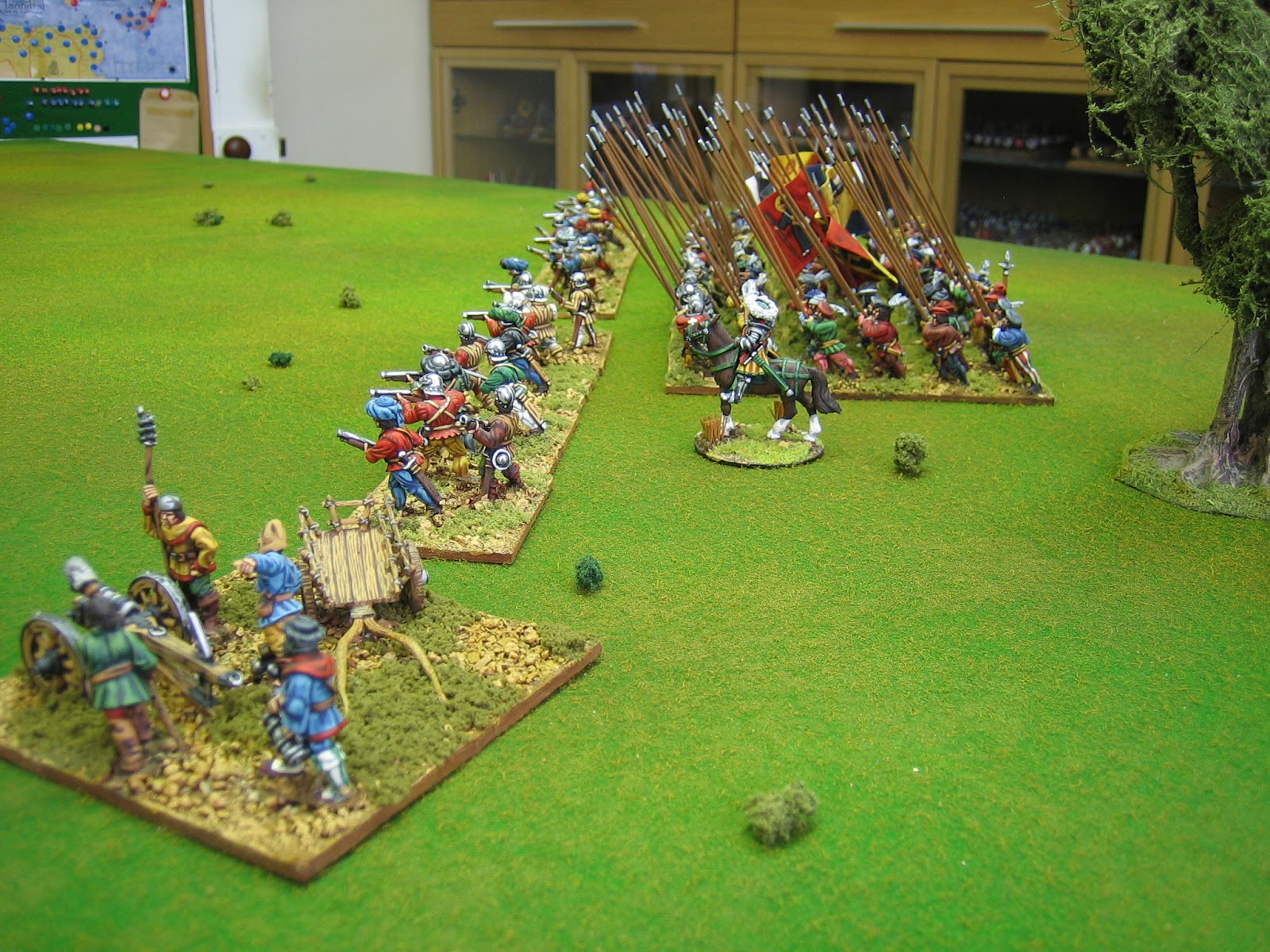
This weekend I finished painting the last of the Swiss pike. This makes the Swiss contingent complete (though more shot, and even more pike, can be requisitioned from other contingents if required).

As a contingent, it comprises:
216 pike, 'collectionally' organised in three 72 man 'pike squares'.
16 halberdiers in a single unit.
24 arquebusier, in two units, based as skirmish shot.

Most figures are Old Glory, but there are one or two Foundry figures mixed in here and there.


The pike squares are organised in 12 stand units. They are four stands (12 figures) wide and three stands (6 figures) deep. Though not exactly square in any sense, they are efficient, and (IMHO) good looking wargames units.
The front stands are, probably unhistorically, armoured. But I like the look of a bit of three-quarter armour where the metal meets the meat.
A halberdiers unit, which I added only for 'spicey, gamey' completeness rather than historical necessity, in a small block of 16 figures.

Men with big choppers do it for me, anyways!


A close up of the relatively bright and simple paint job. These Old Glory figures are a doddle to paint up quickly - I love 'em!
One of the two units of skirmish shot. These are an almost 50% - 50% mix of 'ebay purchased' Foundry and Old Glory. They mix very well.


As I said, I have more Swiss units for refighting big battles such as Marignano. This is a unit of 72 Swiss pike (mainly Foundry figures) which I generally use as French. As with all of my Renaissance units (except one), all flags are on interchangable tubing so, once I make six more Swiss flags on tubing, these can be Swiss again in a seconds.


BTW, the first day of Marignano 1515 is my next painting goal. I have to paint 72 Italian pike (to use, wouldn't you know it, as French!), 48 crossbowmen, 32 arquebusier, and ten or so flags. I'll refight it at a figure ratio of 1:40ish, and with the usual piece of fudge.

For this Wednesday's game I've set up a battle using my entire collection (save a few command stands). It will be the umpteenth, fictional Battle of Fastapasta.

Italian Wars, painting update (March into April)

I have painted quite a bit of stuff since my January post. As well as the stuff pictured here, I have also painted 26 gendarmes and 16 stradiots. These had their own posts last month. Most of the figures pictured below are Foundry and Old Glory. The waggons and horses are Foundry, the barrel waggon is Hinchcliffe (?). The oxen are Front Rank. The Halberdiers are Foundry plus unknowns.

 A unit of landsknecht skirmishers.
A unit of 'generic' skirmish shot - they could Italian or Swiss.
 Another unit of 'generic' skirmish shot.
Some baggage waggons that will serve for most 'horse and musket' periods. That's why they have no crew. When I find some 16th C crew I'll put them on pennies.

The waggons are old, the teams have been repainted.

The waggon in the middle has had a tarp covered load added - using balsa blocks and miliput tarp. The one in the forground had it's tilt added a loooong time ago - I think it is glue soaked cloth over wire tilt bars.
A couple of Swiss (or early Italian) guns. I didn't have quite enough crew for them so I added a scratch built wagon as filler to one of the stands.

These figures only needed re-basing.
A unit of Swiss halberdiers.

The Battle of Novara 6th June 1503.

This is a Hell Broke Loose scenario.

A short historical background
In 1512, following the Battle of Ravenna, France somehow failed to capitalise on her victory. In fact, the campaign proved to be a disaster, and she lost Milan. In mid May 1513, Louis XII of France dispatched an army, under the command of La Tremoille, over the Alps to retake his lost duchy.


By early June, much of the duchy had been retaken, and Tremoille had moved to besiege Novara (the duchy’s second city) where the duchy’s new, Swiss backed duke, Massimiliano Sforza, was holed up with 4000 Swiss.

Shortly after the French invested Novara a Swiss army arrived to its relief. On their approach La Tremoille, not wishing to be caught in his siege lines, withdrew his army. At nightfall, the dispersed units of the French army made camp around the village of Trecate. Unexpectedly, the Swiss did not tarry after their long march to Novara. They linked up with the garrison there and immediately followed up the French as they withdrew. Using local guides they made their way, in the dark, to within striking distance of the French army. Just before dawn, they attacked.

The attack began with skirmish between Swiss ‘enfants perdus’ and French pickets in the village of Trecate. La Tremoille, who had taken a billet in the village, narrowly escaped capture. But, the Swiss skirmishers did not follow up this attack. It was a feint, and their skirmishers withdrew to a wood that lay within shooting distance of Trecate’s houses from where they kept up a noisy fire.

The alarm had been sounded and French troops, bleary eyed and disorientated, were called to stand-to. They had no time to re-doploy to face their attackers – the Swiss were everywhere upon them.

This is where this scenario begins.

French order of battle
When the army invaded it numbered somewhat more than 12,000 men. It comprised 1000 lances of gendarmerie, 1000 light cavalry, 4000 Gascon and Navarrese crossbowmen, 6000 Landsknechts, and was amply provided with artillery.

Army Die: D10
Sequence Deck: D10
Morale Chips: 58
Additional cards: Scenario 1, Scenario 2.

Two commands of gendarmes.

(Motivation die D10).

1. La Tremoille with four units each of 8 gendarmes, all billeted in the village of Trecate. A class, fierce.


2. Robert of Bouillon with one unit of 8 gendarmes, outside Trecate. A class, fierce.
French light cavalry command.

(Motivation die D10).
One unit of 8 mounted crossbows. C class.

One unit of 8 stradiots.C class, grizzled, specialist close skirmishers.
French Gascon and Navarrese infantry command under Sieur de Beaumont.

(Motivation die D10).


Six units of 12 skirmish crossbowmen. D class, specialist crossbowmen.
Landsknceht and artillery command under Flourange.

(Motivation die D10).


One unit of 108 Landsknecht pike. C class, fierce, grizzled, murderous Vs Swiss.

One unit of 12 skirmish shot. C class, grizzled, specialist arquebus.

Two batteries of heavy artillery (1 gun each). D class, specialist for fire.

Milano Swiss order of battle
The Duke's army mustered less than 12,000 Swiss infantry and a few hundred horse of the Duke's bodyguard. The was divided into three bodies which advanced in echelon. The bodies were not equal in numbers. The first had a pike square 1000 strong, the second a pike square 2000 strong, and the third had a pike square of over 6000 strong. This accounts for about 75% of the force. I have no description of the supporting elements that made up the other 25% so I have added some shot and halberdiers. The army was ill supported in artillery - only a few light guns had been dragged up.

Army Die: D10
Sequence Deck: D10*
Morale Chips: 38
Additional Cards: Momentum March.

Milano-Swiss flank attack command under Massimiliano Sforza.

(Motivation Die D10).

One unit of 8 men-at-arms. A class.

One unit of 24 Swiss pike. A class, fierce, murderous Vs landsknechts.
 Milano-Swiss frontal attack command.

(Motivation Die D10).

One unit of 36 Swiss pike. A class, fierce, murderous Vs landsknechts.

One unit of 16 Swiss halberdiers. A class, fierce, murderous Vs landsknechts.

One unit of 12 skirmish shot. B class.
 Milano-Swiss main force command.

(Motivation Die D10).

One unit of 108 Swiss pike. A class, fierce, murderous Vs landsknechts.

Two units of 12 skirmish shot. B class.

One artillery battery (1 gun). D class.


Scenario notes
It is important that the bulk of the French heavy cavalry should not come too easily into the fight. To ensure this, they must be deployed billeted in Trecate (all, including the streets, is Type III + cover terrain). They may only leave the town via a road.

The marshy ground between the town and Landsknechts is Type III terrain. The French camp is Type II terrain. The Wood is Type II + cover terrain. All other terrain is Type I and open.

There is only one special scenario rule. The French sequence deck contains two Scenario cards. If a Milano-Swiss unit is in, or is in contact with, the French camp when a Scenario card is turned the French lose D6 morale chips.


Novara 1513 - Battle report

Last night Peter J. (commanding the French) and Graham H. (Commanding the Milano-Swiss) fought it out at Novara. We used the forces and scenario notes detailed in the previous two posts. The battle was done and dusted from start to finish in the evenings play (just under 3 hours). It was a pretty close run thing and both players enjoyed the encounter (I don't think they were only being polite).

There need to be very few alterations to the scenario for next weeks re-fight, where Peter and Graham will switch sides. The main change, will be the reinstatement of the two French Army Characterisation Deck cards (20 more morale chips) and a change in the definition of the two Scenario cards. It was found, that the French needed a few more morale chips, and the diversionary attacks needed a focus - the French camp. Consequently, the next time we play, whenever the French player turns a Scenario card and there is a Milano-Swiss unit in the French camp, the French player will lose d6 morale chips.

I will try, in the course of the next week, write up the full scenario with historical background, OOBs, and scenario notes in a single post.

Until then, here is the report of last nights clash

Here they come! The Swiss diversionary frontal attack swiftly assault the Gascon and Navarrese infantry.
The Swiss main force pushes its skirmishers forward but, disordered by artillery, their pike square advances tardily.
The Milanese horse and Swiss diversionary attack against the French camp forces back the light troops defending it with ease.
The Swiss frontal attack develops quickly, the Gascons and Navarese are fighting well - much better than expected.
The French gendarmerie is still in Trecate having  breakfast (you can't rush your Wheetabix), arming, and getting their Planchets to pay off the local bed warmers.


At last, Wheetabix eaten, armed, and groins scratched, the Gendarmerie comes out to play.....
...and some of it wishes it hadn't bothered.
As Gascons, Navarese, and gendarmes decide to find lodgings elsewhere, the Swiss diversionary flank attack (in the background) is meeting stiff resistance....
...very stiff resistance - the Milanese horse and Swiss go down to repeated attack from French cavalry. The camp is saved!
Meanwhile, (that new unit of) Swiss halberdiers, having become isolated, launch a frontal attack out of desperation against the best France has to offer. The gendarmerie must have not been as ready as it looked - it was routed, then dragged from their horses and butchered in the streets of Trecate.

Note the French cavalry far to the rear, the battle is almost over and it has only just getting into battle order. It rolled sooooo many odd move dice that it hardly moved in the first turns!
Finally, having suffered horrendous casualties to fire from artillery and arquebus, the landsknechts and Swiss main force come to grips.
The French have been at zero morale chips for some time and the landsknechts are beaten in short order.

The battle is over. The French are beaten.
 

Search This Blog

Popular Posts