I thought that I had only hard copies of the photos I took on a trip to the Czech Republic several years ago. Then, whilst looking for a set of rules for Soldier Kings (that I think are permanently lost), I came across these photos on a disk. They are from 'negative thumbnails' only, but I thought I'd share.
Lobositz
This shot was taken from the Austrian side of the field from just above the Morellen- Bach. There is a drop of several meters to what, pre-drainage, must have been very boggy ground; now the Morellen - Bach is allotments. The drop is steep - definitely a good place to form a defencive line. Across the valley is the Homolka Mound (left) and the Lobosch (right).
Across the Holmolka Mound from just above Wchinitz.
From the Homolka Mound: The Lobosch. The valley between the two is where Frederick deployed the bulk of his 10,000 cavalry.In this photo, they charged from left to right. It is great cavalry ground.
From the Homolka Mound: The town of Lobositz. In the mid distance (centre left), just above the strip of white buildings, is the Elbe.
From the Homolka Mound: The southern end of the field. I believe that the built up area in front of the industrial complex is Sullowitz.
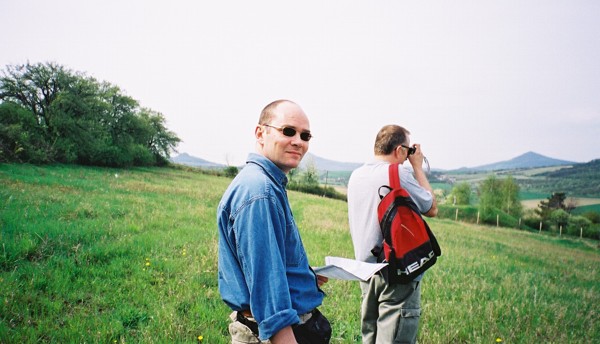
Myself and Mark Dudley on the Homolka Mound. In the far distance, more volcanic mounds - any battle around these parts would probably feature one.
From the edge of Wchinitz: The valley between the Homolka and Lobosch opens out onto a very flat plain. It must have been quite something, 10,000 cavalry moving forward on that misty morning.
....and that volcanic mound really is quite an inspiring battlefield feature. This was one of the best visits to an unexploited (no museum, etc. - not that that is a good thing) battlefield that I've ever made. From the Homolka especially, you can 'see it all happening'.
Kolin
From the top of the slope - looking towards Brzistwi. The tops of the trees you can see are in a short steep sided gorge.
These are the 30 Years War earthworks that must have been used by the Austrians and might explain why they were able to hold the Prussians so easily.
From the earthworks looking down towards the Kaiser Strasse: It is definately higher, definitely a superior position from which to view the enemy, but it is not a slope that would impede movement. What a killing ground.
More earthworks running around the church at Krezechorz.
The church.
The Kolin Monument. I can't rotate the thumbs on the disk.
Currently, my brother-in-law is living in Prague. I intend to revisit Kolin, next year perhaps. This trip was fleeting - perhaps an hour or so - and it left me uninspired. More exploring next time; next time without the (very bored) ladies.
BTW, Chotusitz is also in the area and we went there on route to Kolin. You can see Chirkwitz Pond from the main road, but the rest is covered by a secured military airbase - can assume that it was always billiard table flat? This is one you should, if you have limited time, miss.
Showing posts with label Holidays - the military bits. Show all posts
Fortifications at St. Martin, Ile de Re
I've just got back from a holiday in France. I stayed in the old village of St. Martin, on the island of Ile de Re (Isle of Kings), off the coast of La Rochelle. The village is sited within Vauban fortifications which, except for two modern road entry points, is completely unspoilt. Most of the fortifications are accessible to the public - the one exception is the citadel, which is being used as a high security prison.
The island has been subject to attack, most famously by the Anglo-Dutch fleet under the command of the Duke of Buckingham during the French Wars of Religion: He tried to capture the island. It was this fleet that caused the significant damage to the church - still partially a ruin.
Here are some photos taken during my stay. There are a few more from the top of the church tower which give an idea of the area they cover. I will add them ASAP.
(BTW. The exact position of the rented cottage is at the small green space - a tennis court - between the Route de l'Omeau and Cours Pasteur. As a holiday location I can thoroughly recommend the island).
The gate closest to the citadel. It is accessible.
One of the modern road entrances passes what must be a magazine. It lies just inside the fortifications, opposite the citadel, and the mound affords significant protection from incoming fire.
The bastion complex just two minutes walk from my holiday cottage. This shot shows one of the access points to the ditch - in this case the door to a very dark spiral staircase.
From the same viewpoint, the ditch.
The rear corner of the bastion from the ditch.
Access to the bastion is a narrow stairway.
A sally port in the inner wall.
The sally port inside.
The ravelin gate further along the fortifications. This is almost at right angles to the main gate which lies beyond a further bridge.
A well inside the ravelin gate.
The bridge from the ravelin to the main gate. It is identical to the gate at the citadel end of the fortifications.
A side view of the looong bridge.
The bridge is well covered from the inner defences.
Inside view of the gate.
Just to show the symmetry, a shot taken from the other gate's bridge. Compare with above.
The island has been subject to attack, most famously by the Anglo-Dutch fleet under the command of the Duke of Buckingham during the French Wars of Religion: He tried to capture the island. It was this fleet that caused the significant damage to the church - still partially a ruin.
Here are some photos taken during my stay. There are a few more from the top of the church tower which give an idea of the area they cover. I will add them ASAP.
(BTW. The exact position of the rented cottage is at the small green space - a tennis court - between the Route de l'Omeau and Cours Pasteur. As a holiday location I can thoroughly recommend the island).
The gate closest to the citadel. It is accessible.
One of the modern road entrances passes what must be a magazine. It lies just inside the fortifications, opposite the citadel, and the mound affords significant protection from incoming fire.
The bastion complex just two minutes walk from my holiday cottage. This shot shows one of the access points to the ditch - in this case the door to a very dark spiral staircase.
From the same viewpoint, the ditch.
The rear corner of the bastion from the ditch.
Access to the bastion is a narrow stairway.
A sally port in the inner wall.
The sally port inside.
The ravelin gate further along the fortifications. This is almost at right angles to the main gate which lies beyond a further bridge.
A well inside the ravelin gate.
The bridge from the ravelin to the main gate. It is identical to the gate at the citadel end of the fortifications.
A side view of the looong bridge.
The bridge is well covered from the inner defences.
Inside view of the gate.
Just to show the symmetry, a shot taken from the other gate's bridge. Compare with above.
Moscow and Borodino
I have just returned from a trip to Moscow. Primarily this was a trip to see my brother-in-law Rupert and his family who have recently moved to live there. However, my passion for things military being what it is, it would have been remiss of me not to slip in some visits to a few history museums and a battlefield. As well as planned excursions, Russia is littered with military bits and pieces - roadside tanks etc. Above, my son meets some (bribed) Streltsi in Red Square.
THE BORODINO PANORAMA MUSEUM
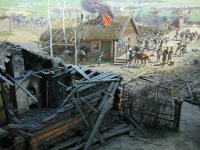
This is a fantastic small museum just down the road from the Great Patriotic War Museum. It has a number of small exhibits and models, but at its centre is the panorama (you stand in the middle) of the battle. This is cleverly done with a 1:1 scale diorama in the fore ground and the painting of the battle behind it.
THE BORODINO MUSEUM AT BORODINO
Rupert (who is also interested in history) had arranged for his driver to take us both to Borodino on the last full day of my visit. It was the military highlight of my trip. By road this is about 120km drive west of central Moscow. Be warned that, because of the horrific traffic in Moscow, this distance takes about two and a half hours each way! However, it is well worth a visit. It has a well appointed (if small) museum opposite the memorial sited at the Great Redoubt. The museum is crammed with interesting exhibits including a large diorama of the battlefield and Kutusov's carriage. It is the ideal place to start, get your bearings and pick up a tour map.
BORODINO FIELD
The battlefield itself has memorials to the (Russian only) fighting formations at their main positions. Although roadside trees now obscure the view from the Russian to the French positions, the battlefield is largely unspoilt.
From the Great Redoubt looking west, looking east and looking north east.
Looking north to the Great redoubt from the midway point between it and the Bagration Fleches, and the Semenkovka stream (which looks like a series of muddy ponds).
The Bagration Fleches (forward?) looking west, looking south, and from the rear. These look like they are modern reconstructions.

Although built in the mid 19C the convent at the Bagration fleches houses one within its grounds. It also has a small museum (disappointing). The convent church is well worth a visit - stunning inside and out. (Rupert centre and his driver Gregory on the left).
THE GREAT PATRIOTIC WAR MUSEUM


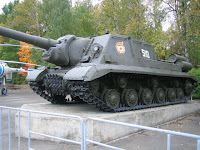


This is a huge building. Unfortunately its contents, though interesting and well presented, did not match the building's external grandeur. However, outside the museum there is a tank and aircraft park which includes a few unusual exhibits including a twin turreted T26, a T26 produced without running gear for fixed defence, some lend lease equipment including a Matilda and Wasp, an armoured train, some Japanese equipment and a few German bits and pieces.


VISITING MOSCOW
Moscow is a city of extremes. It has some wonderful architecture amongst the endless communist high rise apartment blocks; it needs a lot of TLC and some health and safety legislation.
Eating well, etc. is very, very pricey - much more expensive than London and there is no middle ground. Expect a simple 'western' lunch to set you back £15 and a good dinner 4 or 5 times that. Only Petrol and take out booze are inexpensive. All museums have a very reasonable entry fee (£1 - £3) and all allow photography provided you pay for the extra photography ticket.
My honest opinion of Moscow as a whole is that it is worth a visit once - so get everything you need to do done in a single visit. It is an edgy, dirty, wholly corrupt and moth eaten city - after visiting (save for family and friends) you probably will not want to return.
Subscribe to:
Posts (Atom)