FLEET OF BATTLE
Designer Notes
Firstly let me start by saying that you will probably need to have a copy of Field of Battle, or at least have played FoB before, to get the basics of these rules. I have no intention of writing explanations for every card and table because having played FoB it all makes perfect sense to me – plus you really should buy a copy. Having said that, Fleet of Battle is somewhat different in several ways and these differences will be immediately apparent to those with experience of FoB. All changes are detailed in the relevant tables – you just have to fill in the gaps.
I have tried to keep the basic simplicity of galley warfare to the fore throughout the rules: Manoeuvre followed by ramming or boarding.
Because the rules are for fleets numbering tens of ships, rather than a mere handful, several aspects of Field of Battle have been simplified to a large extent to speed play, cut down on record keeping and to concentrate on the key decision making of the players.
One of the key differences is the decision not to adopt the variable defence die. It was found, during early play testing, that this involved too much reference to roster sheets and ‘dicing up’. It was simpler to go for a basic defence die adjusted by target class on the combat tables. This was due to the speed that vessels came to grips with their opponents and the number of multi-combats that take place; this is down to the nature of warfare at sea; a lack of impeding terrain and the narrow frontage of ships. Ancient naval warfare is all about confused collisions and close action – it is wholly dissimilar to linear land action.
The game works best with at least 15 ships per side; optimally with 24 or more per side. I suggest that fleets should be divided into three to six Squadrons, each with its own flagship. Squadrons should be strong; if they have less than five ships each they will lack staying power. All training levels should be the same within a squadron; you may wish to give individual ships different training levels and of course there is nothing stopping you from doing so, but due to the overall complexity of ancient naval battles I advise against it. When working out ship numbers to re-fight historical battles I nominally use a model to ship ratio of 1: 10; historical actions were often very large indeed, they were armies afloat, veritable Armadas, involving fleets of up to 600 ships each.
Because of the number of units I have omitted ship morale rules in all but the most basic sense. Morale is represented on each ship by the number of Crew Integrity – as it drops the capability of the ship drops and on reaching 0 it will surrender or flee. When a squadron (command group) falls below 50% strength (in ships not fleeing, surrendered or sunk) its vessels are subject to fleet morale tests; ships in depleted squadrons are likely to quit the battle zone at a moments notice.
Fleet of Battle is a very bloody game. Sinking ships is quite easy – as it should be in the age of the ram. Making ramming too difficult to achieve or ineffective would create a game of ‘iron clads’ which ships of this period were not (the advice of Donald Featherstone, in his book Naval Wargaming, was taken without hesitation). It has been estimated that a quinquireme could hole another, even at oblique angles, whilst moving at less than 3 knots. A modern reconstruction of a light trireme, in sea trials, was capable of over 10 knots (with a fresh crew) and capable of cruising at 7 knots for long periods.
Boarding actions are usually over quickly. The reason why the size of both vessels is taken into account in the Boarding Action table is due to the expediential rise in the numbers of marines as vessels get larger; it was done to keep the boarding die range within manageable limits: d12 + 8 seemed a little pointless, not to mention overwhelming, especially when, occasionally, Vs d4.
Missilery is included but has been kept fairly ineffective on purpose. This is down to play-testing. We fought one battle with more complex and effective missilery rules – it was like the 7YW! Not ancient naval at all. Note that the Up 1 Vs Aphract ships in the missilery table refers to ships like triremes; Aphract is the opposite of Cataphract and means unenclosed / open.
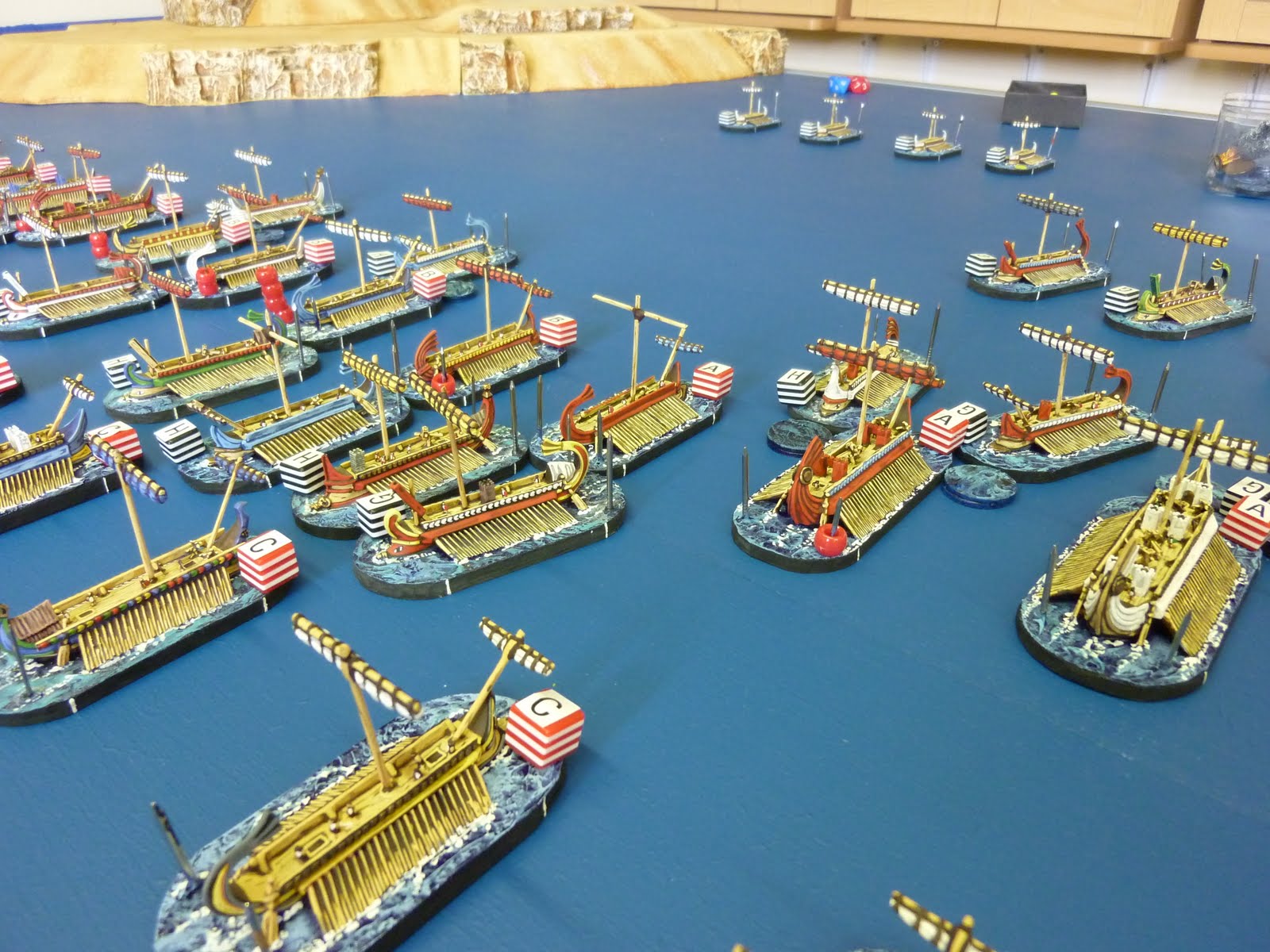
I have tried to do away with as much record keeping as possible by keeping all vessels, when at full strength, at 4 Hull Integrity and 4 Crew Integrity. The difference in the size and power of each ship has been taken care of in its basic statistics and use of up and downs on the combat tables. Indeed, the inherent problems of record keeping are one of the primary reasons why naval wargaming is often neglected – no one likes doing paperwork or referring to endless reams of damage record sheets every time there is a move or combat to resolve. We have found that pins in the vessel’s base over which coloured beads can be placed is the easiest way of following damage. My own bases have four pins, one at the front and three at the back. The one at the front is used for squadron ID, flag ship marker. Those at the back are used for HI, CI and Hole, Surrendered and Flee markers. Apart from a squadron roster, with the number of ships originally in the squadron, ID bead colour, the leadership die and levels of crew training, no other paperwork is required – and this should usually be made out before the action starts to save even more time for actually playing.
One question I keep coming back to is why didn’t I go for three ship units capable of different formations with different abilities? It did cross my mind and I even went so far as paper exercises; but the answer is that, although very little is known about ancient naval warfare – so I could do what ever I liked, it all seemed a little too artificial and un-naval; at sea an action can turn because of one little ship performing miracles! But perhaps in the future I’ll change my mind.
Have fun,
James Roach